

.svg)




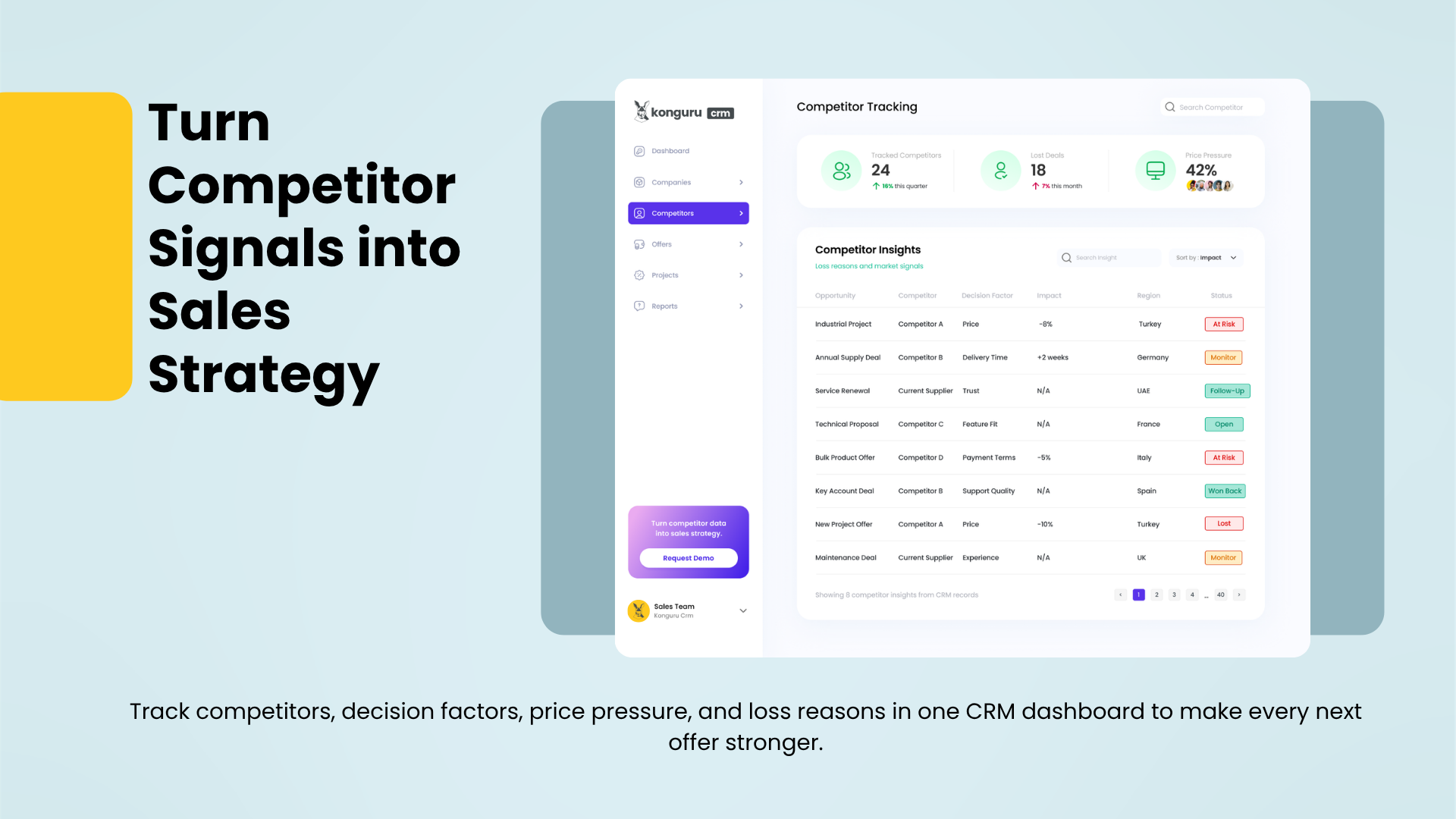
Competitor tracking in B2B sales turns field signals, loss reasons, and decision criteria into a clearer sales strategy instead of reducing competition to price comparison.
WHY DOES COMPETITOR INFORMATION MATTER IN B2B SALES?
Competition in B2B sales is often discussed only through price. Yet understanding why a customer chooses another supplier also requires product fit, delivery time, technical support, trust, payment terms, and previous experience.
Sales teams collect valuable competitor information during customer meetings and field visits. Which brands are being evaluated, which competitor is strong in which product group, what price range is discussed, and which service expectations matter can all shape the next sales move.
COMPETITOR TRACKING IS NOT ONLY PRICE COMPARISON
Competitor tracking is broader than asking who offered the lowest price. Delivery capability, technical suitability, after-sales support, payment terms, and the customer’s existing supplier relationship may all influence the decision.
If this information stays in personal notes, emails, or chats, it never becomes organizational memory. When it is captured in CRM, teams can prepare better for similar opportunities in the same customer segment.
WHAT COMPETITIVE DATA SHOULD BE KEPT IN CRM?
For each opportunity or offer, CRM can hold the competitor name, decision criteria, price pressure, strengths and weaknesses, loss reason, and next action. This helps managers see not only which deals were lost, but also why they were lost.
Keeping competitor information together with offers, visits, and tasks also supports daily sales work. Representatives can see which arguments worked in similar customer profiles.
HOW DO LOSS REASONS TURN INTO SALES STRATEGY?
Was the opportunity lost because of price, delivery time, a missing technical feature, or the customer’s preference to continue with an existing supplier? When these questions are answered consistently, the team becomes better prepared for the next proposal.
Loss reasons also inform product, pricing, and service strategy. Repeated price pressure in a product group may trigger a pricing review. If the same competitor appears in a region, the field strategy can be adjusted accordingly.
CONNECT COMPETITOR KNOWLEDGE TO THE SALES PROCESS WITH KONGURU CRM
Konguru CRM helps manage companies, contacts, offers, projects, visits, and tasks in one structure. When competitor information becomes part of that structure, teams can track not only the status of an opportunity, but also the competitive dynamics behind it.
Request a Konguru CRM demo to turn competitor information and loss reasons into stronger sales strategy.