
.svg)




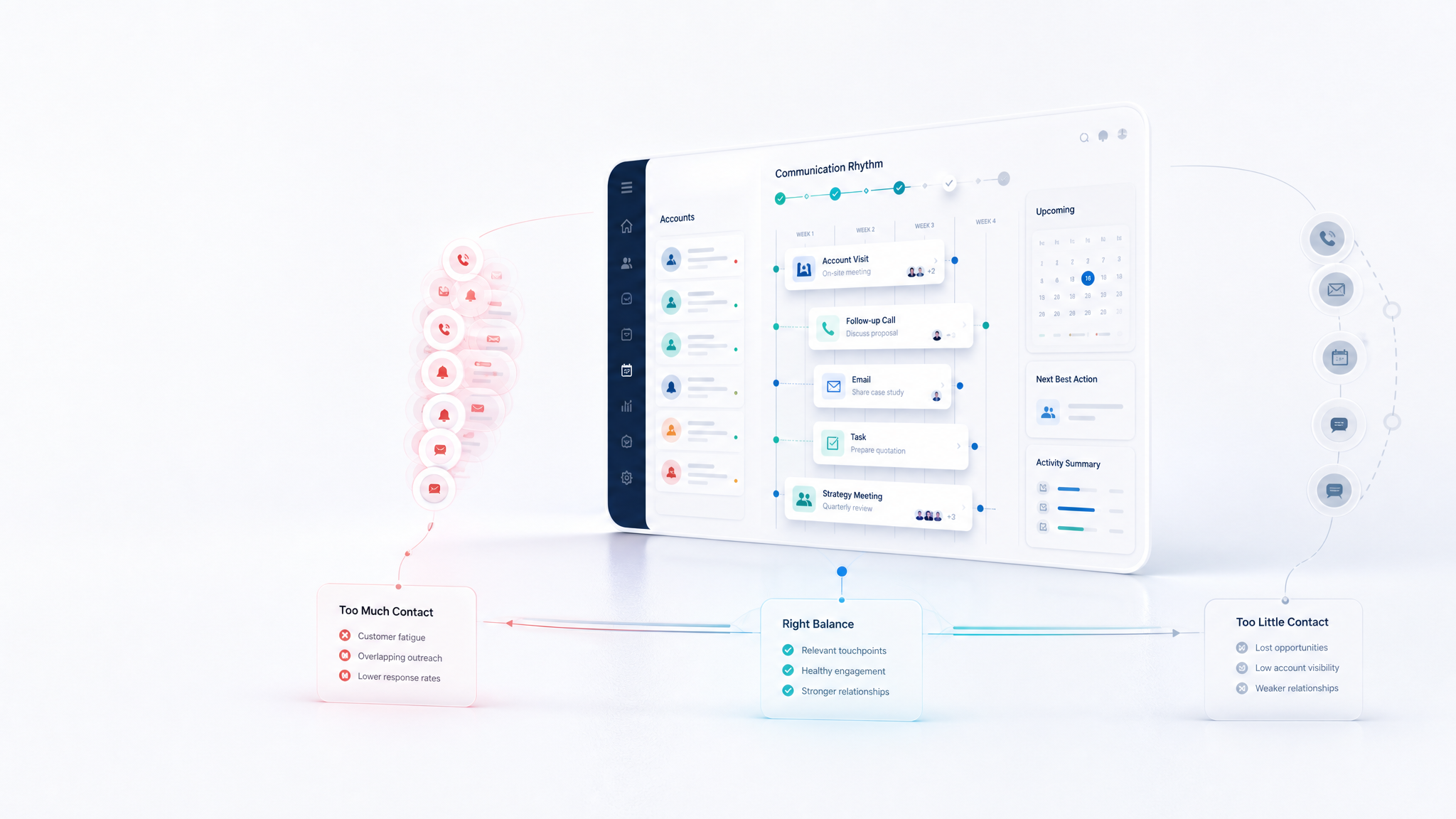
A customer touch frequency policy in CRM helps manage the customer communication rhythm more evenly in B2B relationships by avoiding contact that is either too frequent or too infrequent.
What does customer touch frequency mean?
In B2B sales, how often communication takes place is just as important as communicating with the customer itself. Relationships may weaken with customers who are contacted too rarely, while communication fatigue may develop among customers contacted too frequently and without a plan. Customer touch frequency is the relationship rhythm that defines which channel will be used to contact a customer, for what purpose, and at what interval.
This approach does not focus only on increasing the number of calls or visits. The aim is to establish a meaningful contact standard based on the customer’s value, relationship status, sales potential, industry dynamics, and communication expectations. The sales team therefore moves away from the superficial assumption that “the more contact, the better” and instead contacts customers at the right time and for the right reason.
What risks arise from excessive and insufficient contact?
Contacting a customer more than necessary can have the opposite effect, especially in corporate relationships. A customer who is called every week with similar content or is continually asked about a proposal may perceive the communication as sales pressure rather than a valuable interaction. This reduces the representative’s credibility and lowers the customer’s willingness to respond.
Insufficient contact creates a different risk. Because the customer has not been contacted for a long time, they may share a change in needs with another supplier, disclose information about a new project to competitors, or allow the relationship to become inactive. By the time the sales team contacts the customer again, the opportunity may already have taken shape.
Customer fatigue and communication quality
Customer fatigue is often caused not by the number of interactions, but by the failure of those interactions to create value. Repeating the same questions, failing to remember previous conversations, continually raising subjects in which the customer has no interest, or making contact only to ask for a sale all reduce the quality of the interaction.
When the purpose, result, and next step of past interactions are recorded in CRM, the representative communicates with better preparation. Being able to tell the customer, “we discussed this subject in our last meeting,” makes the interaction more personal and valuable. A frequency policy also provides a framework that supports this quality.
Weakening relationships in silent accounts
Some customers may be strategically important even if they do not purchase regularly. When there has been no communication with these accounts for a long time, the company may miss organizational changes at the customer, new investment plans, or signals of dissatisfaction.
Making silent accounts visible in CRM prevents the sales team from remembering the relationship only when a sales opportunity arises. The purpose is not to call every customer with the same frequency. What matters is setting a minimum contact standard according to the customer’s level of importance.
How should the contact rhythm be set for different customer groups?
Contact frequency should not be governed by a single rule for every customer. Strategic customers, accounts with active opportunities, newly acquired customers, inactive companies with high potential, and accounts that have seen no activity for a long time all require different rhythms.
For example, weekly contact may be necessary with a customer that has an active opportunity, while a value-focused interaction every three months may be sufficient for an inactive customer with potential. A newly acquired customer may need closer follow-up during the initial use or first project period. Distinguishing these groups in CRM makes the contact policy practical to apply.
Which data should be used to monitor contact frequency in CRM?
Information such as the date of the last interaction, contact channel, purpose of the interaction, customer response, planned next contact date, and account priority can be tracked to manage contact frequency. However, this data should be evaluated in context rather than only numerically.
Five interactions in the last month are not good or bad on their own. They may be meaningful if all five were responses to customer requests, but they may damage the relationship if all were unsuccessful sales reminders. CRM should enable the representative to see both the frequency and the quality of contact.
Manage the customer relationship rhythm more evenly with Konguru CRM
Konguru CRM helps track relationship history more systematically through customer meetings, visits, tasks, offers, and notes. When a customer touch frequency policy is added to this structure, the sales team can analyze not only whom it met, but also how often and for what purpose each customer was contacted.
In B2B sales, a sustainable relationship is built neither by forgetting the customer nor by continually disturbing them. The right contact rhythm creates a corporate communication standard that respects customer needs and clarifies the sales team’s priorities.
Request a Konguru CRM demo to manage the frequency of contact with your customers in a more balanced and professional way.