
.svg)



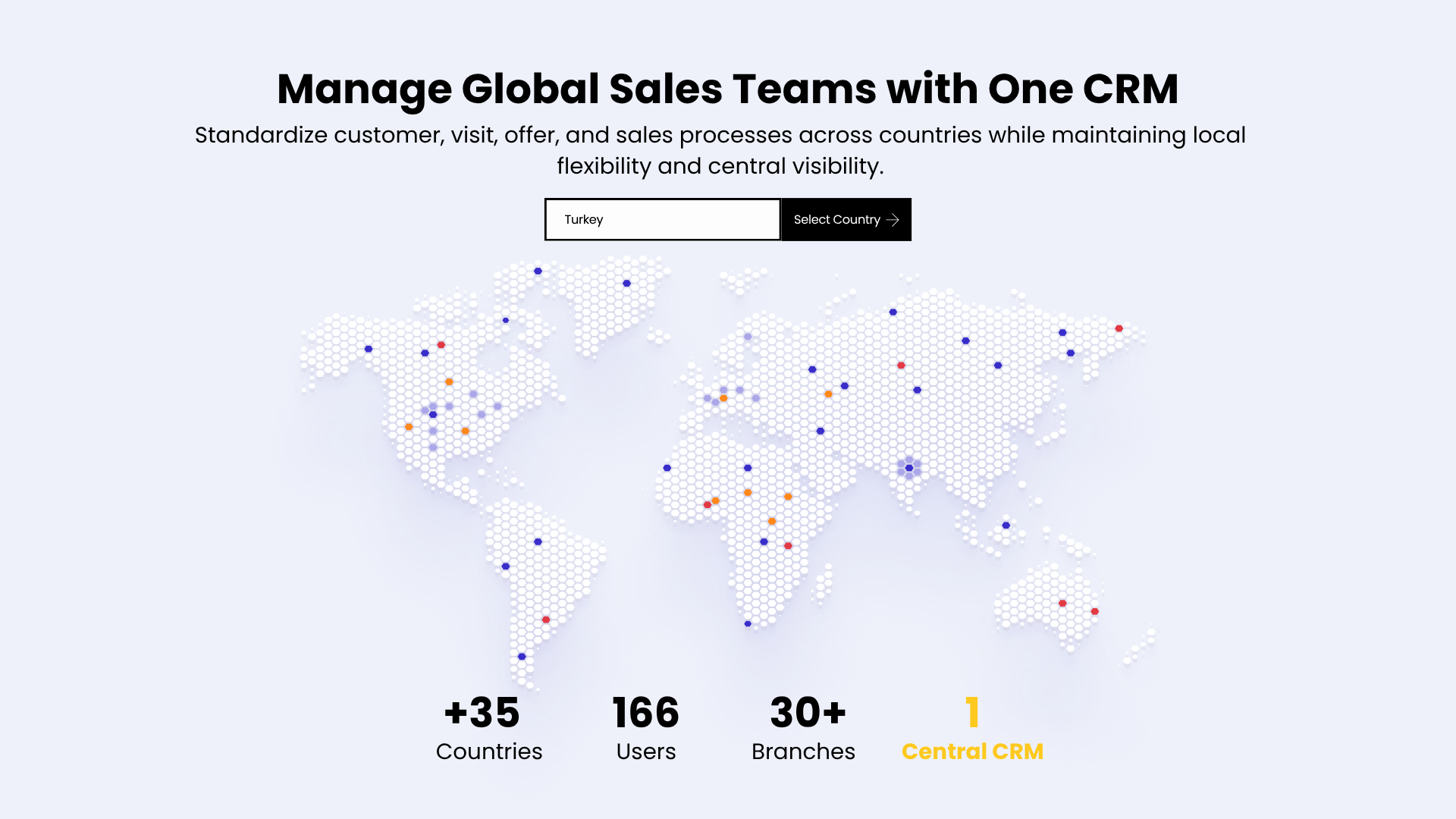
CRM for global sales teams helps manage customer, visit, offer, and reporting processes across countries in a standard structure.
KEY CHALLENGES IN MULTI-COUNTRY SALES OPERATIONS
For companies selling globally, CRM needs go beyond the daily use of local teams. Different countries may have different sales habits, customer types, reporting expectations, and business processes.
If this variety is not managed well, headquarters cannot see the sales operation as a whole. One of the biggest challenges is balancing a standard process with local flexibility.
Each country may have its own customer structure, but customer, offer, visit, and sales data must be tracked in a common language across the company. CRM creates this shared language.
HOW DOES CRM STANDARDIZE PROCESSES?
CRM helps global sales teams follow the same core process. How to open a customer record, store contact information, process visit results, move an offer through stages, and measure sales reports can all be standardized.
Even when countries work in different markets, management can make decisions from the same data structure.
COMMON CUSTOMER AND CONTACT STRUCTURE
Consistent customer data is essential for global teams. The same company may appear in different countries, under group companies, or with related contacts. A common structure is needed.
Standard fields for company, contact, task, and responsibility information make customer relationships easier to manage.
STANDARD VISIT AND OFFER PROCESSES
Visits and offers may move at different speeds in different countries. But when core stages are shared in CRM, headquarters can compare performance.
Which country has high visit density, which market converts offers better, and where follow-up time is increasing become clearer questions.
CENTRAL REPORTING AND LOCAL FLEXIBILITY
In multi-country structures, everything does not need to be identical. Local markets may require different fields or definitions. This flexibility should be designed without breaking central reporting.
Branch, country, region, and team fields in CRM help meet local needs while preserving management visibility.
CRM IN MULTILINGUAL AND MULTI-BRANCH STRUCTURES
Language support improves user adoption in global teams. Users work more comfortably in their own language, while managers evaluate data from different countries through the same reporting logic.
Authorization is also important. Each country should manage its own customer portfolio while headquarters tracks overall performance.
MANAGE GLOBAL SALES OPERATIONS WITH KONGURU CRM
Konguru CRM helps manage companies, contacts, visits, offers, sales, tasks, and reporting centrally. For multi-country sales teams, this structure supports process standards and management visibility.
Request a Konguru CRM demo to manage global sales teams with shared processes and stronger cross-country visibility.